Disclaimer:
This article is published by 2Firsts with the author’s permission. The views expressed are solely those of the author and do not necessarily reflect the views of 2Firsts.
Key Points
In this article, the author argues that:
- Global regulation of modern nicotine products varies widely, and these differences cannot be fully explained by public health evidence alone.
- Based on the author’s review of 21 jurisdictions, countries with state ownership of tobacco enterprises or significant fiscal dependence on tobacco revenue are far more likely to impose bans or severe restrictions on vaping and other novel nicotine products, with an estimated prohibition rate of around 75%, compared with approximately 10% in free-market economies.
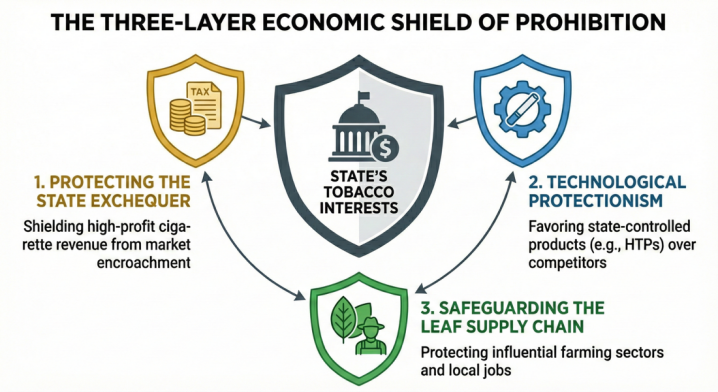
- The article argues that such prohibitive policies are driven by three overlapping economic considerations: protecting cigarette tax revenues, favoring state-controlled technological pathways, and safeguarding domestic tobacco farming interests.
- According to the author, these economic incentives help explain why, despite similar scientific evidence, some governments promote harm-reduction products while others choose prohibition.
By Samrat Chowdhery
The global discourse surrounding modern nicotine substitutes is framed through the lens of public health, but a strictly health-based analysis fails to account for the inconsistent regulatory trajectories observed worldwide. Why does the United Kingdom promote vaping as a cessation tool while Thailand incarcerates tourists for possessing an e-cigarette? Why does Japan ban nicotine e-liquids but allow heated tobacco sticks? The answers lie not in differing interpretations of medical science, but in the divergent economic incentives of the state.
The World Health Organization's Framework Convention on Tobacco Control (FCTC) warns against the influence of "vested interests" in this public health space in Article 5.3, yet contrary to the popular perception of the tobacco industry as a monolith of Western multinational corporations, governments are the largest players in the global tobacco trade. State-Owned Enterprises (SOEs) and government-linked monopolies produce more than half of the world's cigarettes.
These regions' tobacco control architecture is defined by an unacknowledged conflict: the dual role of the state. On one hand, the government is the steward of public health, charged with regulating and minimizing the harm of tobacco consumption. On the other, it is a major, if not the largest, beneficiary of the tobacco trade, acting in many cases as an investor, operator or direct monopolist.
A comprehensive review of twenty-one jurisdictions with verified state ownership or significant financial stakes demonstrates a statistically significant correlation between state involvement in the combustible tobacco trade and the implementation of prohibitive policies against disruptive nicotine technologies.
While nations with free-market tobacco systems, such as the United Kingdom and most Western nations, largely regulate these products as part of a harm reduction strategy, with a ban percentage of around 10%, state-stake nations show an approximate 75% rate of prohibition or severe restriction: 16 of the 21 ban at least one category of novel products such as vaping, heated tobacco and nicotine pouches, while 14 ban vaping.
This figure rises to almost 85% if one includes "Leaf Republics" like Brazil, Argentina, Turkey, and others that may not have SOEs but are heavily influenced by tobacco agriculture.
The data indicates that this stark regulatory disparity stems not from conflicting medical assessments but rather from three potent economic strategies employed to safeguard national revenue from market instability.
Protecting the State Exchequer
The primary impetus for prohibition is the state's imperative to shield its consistent, high-profit cigarette revenue from market encroachment. Across various jurisdictions, the financial scale of the tobacco industry is considerable, engendering a "sovereign conflict of interest" wherein commercial imperatives take precedence over public health considerations.
In areas governed by a total state monopoly, the tobacco corporation functions essentially as a governmental financial institution. For instance, the China National Tobacco Corporation (CNTC) is the world's largest cigarette maker and contributes an estimated 7% to 12% of total central government revenue. For this leviathan, the rise of independent vaping represents a financial threat.
The government’s regulatory response, including the amendment of the Tobacco Monopoly Law to bring e-cigarettes under the State Tobacco Monopoly Administration (STMA) and the implementation of a sweeping flavor ban, appears to be designed to capture the sector and dent its local appeal, thereby preventing it from significantly impacting core combustible sales. The goal was not eradication but consolidation and preservation of state control.
Instead of absorbing the new-technology trade like China, some states relying on monopolies as critical revenue generators for a cash-strapped treasury, such as the Tobacco Authority of Thailand (TAT), Vietnam National Tobacco Corporation (Vinataba) and the Regie systems of the Middle East and Africa, have opted for strict bans or severe restrictions on vapes.
For these governments, the decrease in cigarette sales directly and immediately reduces important revenue from taxes and profits. Therefore, the prohibition policy acts as a key financial protection, safeguarding the established tax and revenue system from the unstable and divided market of new products.
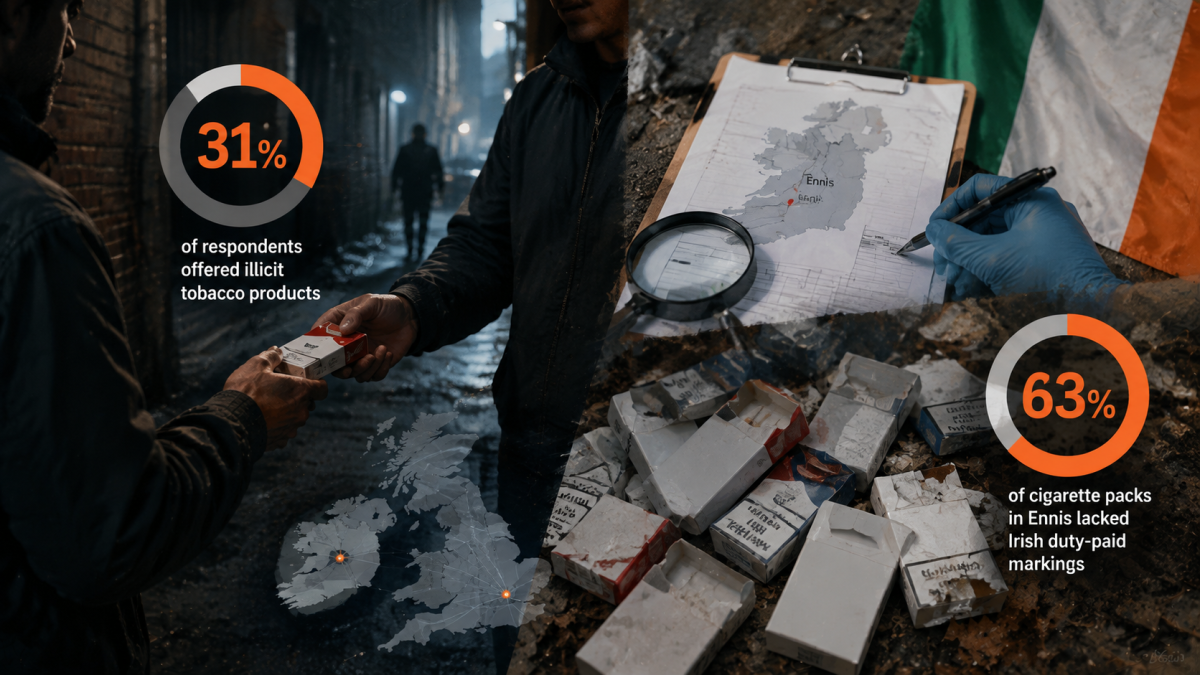
However, the prohibition has been mostly ineffective, rendering this approach to be the most futile and self-sabotaging, as it has given rise to a robust black market, draining the economy.
Selective Regulatory Co-option
In some cases, the regulatory approach of state-controlled countries does not involve a complete ban. Instead, it takes the shape of a strategic form of technological protectionism. Regulations are often designed to allow products that the state-owned entity can produce or control, while restricting those that would benefit independent competitors. This approach seeks to direct any unavoidable consumer migration towards a product that fortifies the state's industrial sector.
The divergent regulatory approaches to vaping and heated tobacco products (HTPs) exemplify this. Open-system vapes, which often also employ synthetic liquid nicotine, are generally manufactured by consumer electronics firms, thereby circumventing the conventional tobacco leaf supply chain and production infrastructure. Conversely, HTPs, which utilize compressed tobacco leaf sticks, integrate into the established agricultural and manufacturing capacities of major, established tobacco corporations.
In nations with a direct state stake, such as Japan, this distinction is fundamental to regulatory policy. The Ministry of Finance possesses a mandated 33% share in Japan Tobacco. Japan, while prohibiting liquid nicotine vaping, classifying it as a pharmaceutical, boasts the world's largest and most robust market for heated tobacco products (HTPs), which are allowed. This situation isn't as contradictory as it seems. JT produces Ploom, an HTP. By outlawing vapes, the government removed competition in a sector where its own product wasn't a clear leader, while encouraging the expansion of HTPs, a market where its financial interests were safeguarded.
A similar pattern emerges in Taiwan market, where state-run Taiwan Tobacco & Liquor Corporation (TTL) banned vaping but incorporated HTPs into its distribution networks, effectively serving as exclusive agents for multinational corporations.
This strategic appropriation enables the state to secure financial gains from the consumer demographic that is transitioning while simultaneously impeding the fragmented, technologically advanced competition that is difficult to regulate or tax. Consequently, this policy is not a matter of moral consideration regarding potential harm; rather, it represents an industrial policy aimed at market dominance.
Safeguarding the Leaf Supply Chain
Innovative nicotine products that employ synthetic or extracted nicotine present a challenge to the politically and economically influential tobacco farming sector. Within numerous state-stake nations, the agricultural sector constitutes a significant voting bloc and a crucial source of employment in rural areas.
Consequently, a third regulatory approach arises: the prohibition of any product that jeopardizes the existing leaf supply chain.
This mechanism is observable in Latin American countries such as Brazil, the world’s second-largest exporter of tobacco leaf, as well as Argentina and to a smaller extent other cigar-producing Caribbean nations, along with Turkey, which despite lacking state-owned manufacturing monopolies, exhibit a reliance on the tobacco agricultural sector.
Although manufacturing has been privatized, the political influence of the tobacco farming lobby effectively functions as a substitute for the state monopoly. The bans and restrictions on vapes in Brazil and Paraguay, for instance, were implemented to shield local tobacco farmers from the potential threat posed by products that do not necessitate local leaf.
The situation in India further illustrates this trend. The 2019 total ban on e-cigarettes and HTPs was a clear protective measure for the government's investment in the country’s local cigarette industry and, crucially, for the livelihoods associated with the vast, traditional bidi (hand-rolled cigarette) and smokeless tobacco (gutkha) industries, along with the tobacco farmers.
Likewise, in Thailand, the government’s resolve to maintain a total ban is significantly bolstered by the powerful tobacco farming lobby in the northern provinces, who view vapes that do not use Thai tobacco as an existential threat.
Collectively, the evidence strongly suggests that the policy of prohibition in state-stake nations is not a singular, monolithic health policy, but a strategic economic response comprisng three reinforcing layers: a revenue immunization wall to protect the tax base, a shield of technological protectionism to control new markets, and an agricultural shield to preserve the politically important leaf supply chain.
This confirms that when the government is the merchant, public health policy frequently becomes a subsidiary of the profit motive. Tragically, instead of countering these forces, the WHO and its public health allies have weaponized these profit motives and have become willing participants in denying millions of tobacco users access to safer nicotine substitutes.
The Way Forward
The tobacco control establishment is often accused of not even acknowledging the influence of state monopolies citing the sovereignty clause, and the sections that have grudgingly recognized the elephant in the room have formulated policy responses of using regulatory oversight to cast it out, sever ties, and try to decimate it, none of which address the economic drivers discussed above and have therefore been summarily ignored.
A more effective strategy would be to pull on the very profit levers driving cigarette and toxic tobacco protectionism to guide this industry towards risk minimization. The cigarette trade is now valued at $1 trillion, rising over 100% from $500 billion since the FCTC was adopted in 2003. Yet, consumers are dissatisfied. Better alternatives are already available, and the market can be lucratively subdivided, just as has happened with the caffeine segment.
Getting even a small share of this market could generate billions in profits. All of which will bring ever more competition for more of the market. Developing nations which rely on tobacco revenue, producing and consuming most of it, are well-poised to capitalize on this consumer shift by creating multi-billion-dollar revenue streams that are aligned with health and fiscal goals.
China’s recognition and absorption of this future product landscape through calibrated legislation, despite its current flaws, presents the most effective response, while the lazy, prohibitionary approach backed by the WHO is serving merely to prolong the dead economy of toxic tobacco, while draining public coffers and putting more lives at risk.
The author is a nicotine policy expert based in Mumbai, India.