Editor’s Note (September 14, 2026): This article has been updated to clarify different estimates for global heated tobacco product use cited across GSTHR publications. The 2026 Situation Report uses approximately 48.9 million as its primary estimate for HTP users in 2024, while related research produced higher estimates under alternative methodologies and a separate GSTHR 2026 briefing cited approximately 78 million users. The article has been revised to distinguish these different estimates and methodologies. 2Firsts thanks a reader for flagging the discrepancy.
Key Points
- GSTHR estimates about 200 million people worldwide use what it terms “safer nicotine products,” including vapes, heated tobacco, nicotine pouches and snus.
- The report says use of non-combustible products rose while smoking rates fell in 28 countries analyzed.
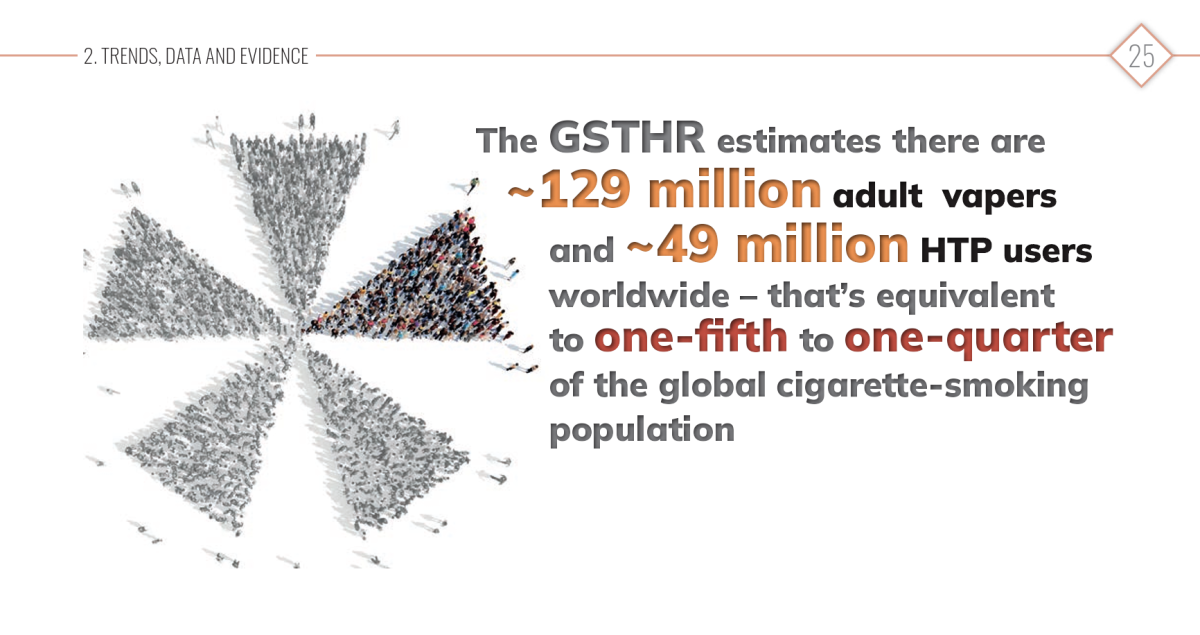
- Global adult vaping users were estimated at about 129 million in 2025, while the GSTHR 2026 Situation Report gives a primary estimate of approximately 48.9 million heated tobacco product users in 2024. Other GSTHR materials have cited a higher estimate of around 78 million.
- GSTHR is operated by Knowledge·Action·Change and funded by Global Action to End Smoking, whose predecessor historically received funding from Philip Morris International.
2Firsts
September 10, 2026
According to The Global State of Tobacco Harm Reduction 2026: A Situation Report, published by the Knowledge·Action·Change-operated Global State of Tobacco Harm Reduction project, about 200 million people worldwide now use non-combustible nicotine products including vapes, heated tobacco products, nicotine pouches and snus.
The report says use of these products has increased alongside declining smoking rates in 28 countries it analyzed, which GSTHR presents as evidence of a broader shift away from combustible tobacco.
About 200 Million Users Worldwide
GSTHR groups vaping products, heated tobacco, nicotine pouches and snus under what it calls “safer nicotine products.”
It estimates that about 200 million people globally use products within these categories.
That figure does not mean 200 million people have completely stopped smoking.
Some users may continue to smoke cigarettes while using other nicotine products, and there may also be overlap between product categories.
Media descriptions suggesting that “200 million people have said goodbye to cigarettes” therefore go beyond what the report itself can establish.
Global Vaping Users Estimated at 129 Million
Among the individual categories, vaping has one of the most developed global user estimates.
GSTHR cites research estimating that about 129 million adults worldwide used vaping products in 2025.
The estimate was published in the peer-reviewed journal Global Epidemiology.
For heated tobacco products, the GSTHR 2026 Situation Report gives a primary estimate of approximately 48.9 million users worldwide in 2024, with a range of 45.6 million to 52.1 million. Related peer-reviewed research produced higher estimates under alternative methodologies, and a separate GSTHR 2026 briefing cited approximately 78 million users.
GSTHR also notes that robust global estimates are not currently available for nicotine pouch and snus users. Category-specific figures should not be added directly because some consumers may use more than one type of product.
28 Countries Show Rising Use Alongside Falling Smoking Rates
GSTHR examined changes in non-combustible nicotine use and smoking prevalence across 28 countries.
The report says the markets showed a common pattern: use of vaping, heated tobacco or other non-combustible products increased while cigarette smoking rates declined.
GSTHR describes this pattern as a “scissor effect,” with the two trends moving in opposite directions.
The finding is observational, however.
The data do not by themselves establish that increased use of non-combustible products caused smoking rates to fall. Tobacco taxes, smoke-free laws, changing health behavior, demographics and other tobacco-control measures may also affect smoking prevalence.
GSTHR Says Regulation Is Tightening
The report also argues that growing consumer use of non-combustible nicotine products is occurring alongside tighter regulation in parts of the world.
GSTHR says some countries continue to prohibit vaping products, nicotine pouches or other alternatives while combustible cigarettes remain legally available.
Knowledge·Action·Change argues that such policies restrict adult smokers’ access to alternatives and calls for wider adoption of tobacco harm reduction policies.
Those conclusions reflect the policy position of GSTHR and its operator.
Funding and Organizational Background
GSTHR is operated by the U.K.-based public health organization Knowledge·Action·Change.
Its 2026 work is funded by Global Action to End Smoking.
Global Action to End Smoking was previously known as the Foundation for a Smoke-Free World and historically received funding from Philip Morris International.
Global Action says it has not accepted funding from tobacco or non-medicinal nicotine companies since 2023, while PMI has said its previous funding arrangement with the organization ended that year.
The World Health Organization has criticized the organization over its historical relationship with PMI and has advised public health bodies against engaging with it.
That funding history does not by itself invalidate the report’s underlying data, but it is relevant when distinguishing GSTHR’s policy conclusions from independent public health or government assessments.
Non-Combustible Nicotine Use Continues to Expand
Regardless of debate around the report’s policy recommendations, the compiled figures indicate that non-combustible nicotine products have established a substantial global user base.
Vaping now has an estimated 129 million adult users globally, while the GSTHR 2026 Situation Report puts heated tobacco product users at approximately 48.9 million under its primary estimate. Nicotine pouches continue to expand in markets including the United States and Europe.
For the industry, the next question is not only whether the user base continues to grow, but also whether regulatory access remains stable and whether long-term national data show sustained declines in cigarette use as alternative products expand.
GSTHR’s 28-country analysis adds another global dataset to that debate, while the relationship between product uptake and smoking decline remains a subject for further independent research.
Follow 2Firsts for timely updates on global tobacco and nicotine regulations, market developments and industry trends.
Cover Image: Global State of Tobacco Harm Reduction
Disclaimer
This article is provided solely for professional research, industry discussion, and informational purposes. Any references to brands, companies, products, technologies, or policies are made for factual reporting and analytical purposes only, and do not constitute endorsement, recommendation, promotion, or advertising by 2Firsts.
Nicotine-containing products, including but not limited to cigarettes, e-cigarettes, heated tobacco products, and nicotine pouches, carry significant health risks. Readers are responsible for complying with all applicable laws and regulations in their respective jurisdictions, including age restrictions and access limitations.
The information contained in this article should not be regarded as investment, legal, medical, regulatory, or commercial advice. While 2Firsts strives to ensure the accuracy and reliability of its content, it does not assume liability for any direct or indirect loss arising from errors, omissions, inaccuracies, or reliance on the information contained herein.
This article is not intended for individuals below the legal age for accessing tobacco or nicotine-related information in their jurisdiction.
Copyright Notice
This article is either original content produced by 2Firsts or content reproduced, translated, summarized, or adapted from third-party sources with attribution where applicable. The intellectual property rights of the original content remain with 2Firsts or the respective original rights holders.
No individual or organization may copy, reproduce, distribute, republish, modify, translate, or otherwise use this content without prior authorization. Any unauthorized use may result in legal action.
For copyright-related inquiries, corrections, or removal requests, please contact: info@2firsts.com.
AI-Assisted Translation and Editing Notice
Portions of this article may have been translated, edited, or reviewed with the assistance of artificial intelligence tools to improve efficiency and readability. Due to the limitations of AI-assisted translation and editing, discrepancies, omissions, or inaccuracies may exist when compared with the original source.
Where applicable, readers are advised to refer to the original source for the most complete and accurate information. If you identify any errors or believe that any content infringes upon your rights, please contact us at info@2firsts.com, and we will review and address the matter promptly.