Key Points
- Risk-Based Policy: Douglas argued that the “continuum of risk” should play a central role in tobacco policy, with regulation, taxation, pricing and enforcement reflecting differences in product risk.
- Beyond Litigation: He said litigation was a major breakthrough in U.S. tobacco control, but future progress requires a broader public health and regulatory ecosystem.
- PMTA Reform: Douglas said possible FDA changes to the PMTA review process could be a “welcome correction” if they create a more efficient and predictable pathway for scientifically substantiated lower-risk products.
- Authorization Is Not Enough: He stressed that market authorization alone does not deliver public health benefits without accurate risk communication, consumer trust and effective enforcement.
- Youth Protection and Harm Reduction: Douglas argued that protecting young people and advancing harm reduction are not mutually exclusive goals.
2Firsts
NEW YORK, Sept. 25, 2026
Cliff Douglas, principal of Tobacco Control Law & Policy Consulting, called for the continuum of risk across tobacco and nicotine products to play a central role in tobacco policy, arguing that the next stage of tobacco control should focus more directly on reducing exposure to combustion and accelerating the displacement of combustible cigarettes.
Douglas spoke at the 2026 New Approaches Summit in New York, held under the theme “Saving Lives in the 21st Century.” His presentation, Beyond Litigation: Building a Public Health Ecosystem to End Smoking, examined how regulation, market access, enforcement, risk communication and other public health tools could work together to accelerate the transition away from combustible cigarettes. 2Firsts is reporting on the summit from New York.
According to biographical information published by the American Cancer Society and Global Action to End Smoking, Douglas has spent decades working across U.S. tobacco control, public health policy and litigation. He previously served as vice president for tobacco control at the American Cancer Society, advised the U.S. Assistant Secretary for Health and the Office of the Surgeon General on tobacco policy, and participated as co-counsel or an expert consultant in state attorney general litigation against the tobacco industry in the 1990s and other major tobacco cases. In October 2023, he was named president and CEO of the Foundation for a Smoke-Free World, which later became Global Action to End Smoking; he left the organization in 2025.
That background provides important context for his remarks at NAS 2026: Douglas is not approaching litigation as an outside observer, but as someone who spent part of his career working within the tobacco-control and legal systems he now argues must be complemented by a broader regulatory and public health framework.
From Litigation to a Broader Public Health Ecosystem
Douglas began by asking how tobacco control might look if policymakers could design the system again from scratch, using what is now known about smoking, nicotine, combustion, addiction, human behavior, product innovation and regulation.
“Not a chance,” he said when asking whether such a system would look like the one that exists today.
He pointed to a marketplace in which combustible cigarettes remain deeply entrenched and readily available while lower-risk alternatives can face uncertain and lengthy routes to legitimate market access. He also highlighted the coexistence of a large illicit market with a much smaller authorized market, as well as continuing difficulty among consumers and health professionals in distinguishing the risks of different nicotine products.
If starting over, Douglas said, he would organize the system around one overriding public health objective: reducing exposure to combustion as rapidly as possible.
During a subsequent panel discussion, Douglas made clear that moving “beyond litigation” did not mean dismissing the role litigation has played in tobacco control.
Reflecting on tobacco litigation in the 1990s, he said legal action had partly emerged amid what he described as an “abdication of responsibility” elsewhere, including in Congress and state legislatures. Litigation, he said, had “occurred in a vacuum” when other institutions had not adequately acted on the smoking epidemic.
At the same time, Douglas described that litigation as a “breakthrough.” He also noted that litigation can feed into regulatory and other policy processes, helping generate subsequent action.
Risk Continuum as an Organizing Principle
Douglas said the diversification of the nicotine market has made traditional measures of tobacco-control progress increasingly insufficient.
For decades, he said, reducing overall tobacco use was a reasonable shorthand for reducing harm because cigarettes overwhelmingly dominated the marketplace. Today, however, products occupy markedly different positions along a continuum of risk.
“What really matters now,” Douglas said, is not simply whether people use a product classified as tobacco, but which products they use and where those products fall on that continuum.
He cited 2024 U.S. data showing that among adults aged 18 to 24, 3.4% smoked cigarettes while 14.8% used e-cigarettes. The figures are confirmed by the National Center for Health Statistics’ 2024 National Health Interview Survey analysis.
Douglas did not characterize vaping as harmless or desirable for people who have never smoked. Rather, he cited the figures as evidence, in his view, that the nicotine marketplace is changing and that combustion need not remain the dominant way nicotine is consumed by successive generations.
The continuum of risk, he said, should therefore do more than describe differences between products. It should play a central role in organizing policy.
Douglas called for regulatory, tax and pricing policies to reflect differences in risk, alongside rigorous product standards and strong protections against youth use. He also emphasized the need for clear and predictable regulatory pathways, saying companies developing lower-risk products should know what evidence is required and be able to expect timely decisions when they meet the relevant standard.
Enforcement, he said, should distinguish between a legitimate regulated marketplace and an illicit one, while public communication should provide adults who smoke with accurate information about relative risk. The system, he added, should continue to adjust as science, products and the marketplace evolve.
Douglas Points to Possible FDA PMTA Changes
Douglas connected that broader framework to a regulatory development reported just days before the summit.
He referenced a Sept. 23 report by The Wall Street Journal that the U.S. Food and Drug Administration is expected to revisit its 2021 final rule governing premarket tobacco product applications, or PMTAs, as part of an effort to accelerate market authorization reviews for e-cigarettes and nicotine pouches.
As 2Firsts reported on Sept. 24, the reported changes could include simplifying some scientific study requirements, shortening review times and providing greater flexibility in the review of applications for noncombustible nicotine products. As of Sept. 25, FDA had not formally announced a rule change implementing the reported measures, and the statutory “appropriate for the protection of the public health,” or APPH, standard remained unchanged.
“The devil will be in the details,” Douglas said.
But if the changes succeed in creating “a more efficient, predictable pathway for scientifically substantiated lower-risk products,” he said, they would represent a “welcome correction.”
The reported development comes as FDA has already been testing ways to make PMTA reviews more efficient. In 2025, the agency launched a nicotine-pouch review pilot that included more direct communication with applicants. FDA later said the process allowed it to complete scientific review of six on! PLUS nicotine pouch applications in record time and that it would evaluate whether lessons from the pilot could be applied more broadly to the PMTA program. FDA’s announcement on the nicotine pouch pilot results provides additional details.
“Authorization Alone Is Not a Public Health Strategy”
Even a more efficient authorization process, however, would not by itself achieve the public health objective Douglas described.
“Authorization alone is not a public health strategy,” he said.
A lower-risk product may accomplish little, Douglas said, if adults who smoke do not know about it, misunderstand its relative risk, do not trust it, cannot distinguish it from illicit products, or do not find it satisfactory enough to replace cigarettes.
He pointed to research cited by FDA showing that only about one in five adults who smoke believed e-cigarettes contain fewer harmful chemicals than cigarettes. An FDA commentary on relative-risk perceptions reported the same finding and noted that, while no tobacco product is safe, available scientific evidence indicates that tobacco products exist on a continuum of risk, with cigarettes being the most harmful.
For Douglas, that makes risk communication part of the regulatory challenge rather than a separate issue.
He said communication should involve not only FDA but also the medical community, consumer organizations and the media, so that adults who smoke have more accurate information on which to base decisions.
Youth Protection and Harm Reduction
Douglas also argued that youth protection and harm reduction should not be treated as mutually exclusive objectives.
He contrasted youth e-cigarette use in 2019 with substantially lower levels in 2025. In 2019, 27.5% of U.S. high school students reported current e-cigarette use, according to the CDC’s National Youth Tobacco Survey analysis.
By 2025, 7.1% of high school students reported current e-cigarette use, while the rate among middle and high school students overall was 5.2%. Current cigarette use among all surveyed students stood at 1.4%, according to FDA’s 2025 National Youth Tobacco Survey findings.
Douglas cited the decline as evidence for his view that protecting young people and advancing harm reduction “aren’t mutually exclusive objectives.”
“We can do both,” he said.
His proposed public health ecosystem extends beyond product authorization. Douglas listed prevention, cessation, clinical care, surveillance, product standards, regulatory predictability, enforcement, accurate communication about relative risk, responsible innovation and accountability when companies violate the rules.
Those elements, he said, need to work together to create conditions in which lower-risk alternatives can compete successfully with combustible cigarettes.
Finding Common Ground in a Polarized Debate
Douglas also placed the policy discussion in the context of what he described as years of deep polarization within tobacco control.
He said disagreements too often turn into accusations of bad faith or moral failure, making constructive dialogue more difficult.
“We should be able to disagree vigorously and still identify substantial common ground,” Douglas said.
The point echoed the broader focus of the summit session, which honored the late tobacco-policy expert Scott Ballin and emphasized dialogue across longstanding divisions in public health.
For Douglas, however, the ultimate policy question was more concrete than whether any one product should receive authorization: what kind of public health and regulatory system would most rapidly reduce disease and death caused by smoking.
He described the objective as building “an ecosystem in which combustible cigarettes steadily lose their place,” with regulatory leadership helping accelerate the transition away from combustion.
Follow 2Firsts for the latest coverage from the 2026 New Approaches Summit.
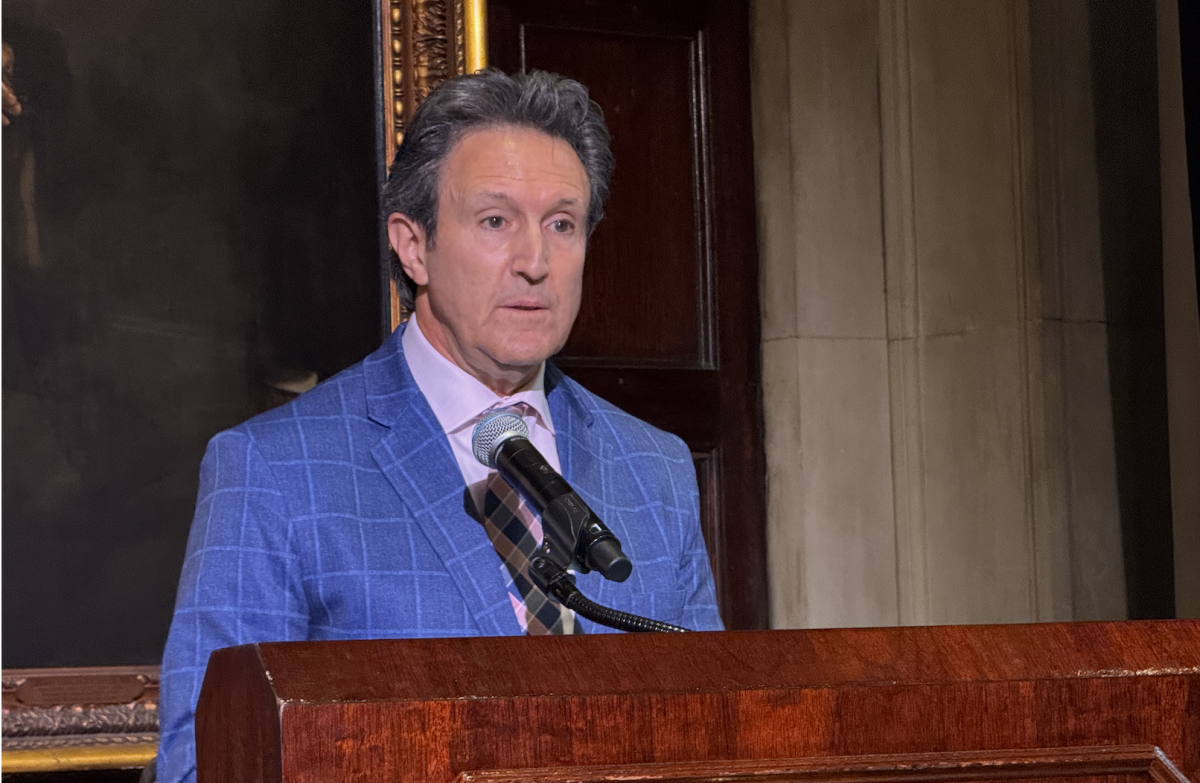
Cliff Douglas speaks at the 2026 New Approaches Summit. Photo by 2Firsts.
References
- American Cancer Society. “Veteran Tobacco Control Expert to Head American Cancer Society Center for Tobacco Control.” May 6, 2015. https://pressroom.cancer.org/CliffDouglas
- Global Action to End Smoking. “Foundation for a Smoke-Free World Names Clifford Douglas CEO.” Oct. 12, 2023. https://globalactiontoendsmoking.org/news-and-press/press/foundation-for-a-smoke-free-world-names-clifford-douglas-ceo-as-global-voice-in-smoking-cessation-work/
- Global Action to End Smoking. “Global Action Announces Structural Changes.” June 10, 2025.https://globalactiontoendsmoking.org/news-and-press/press/global-action-announces-structural-changes/
- National Center for Health Statistics. “Cigarette and Electronic Cigarette Use Among Adults by Urbanization Level: United States, 2024.” https://www.cdc.gov/nchs/data/hestat/hestat115.htm
- 2Firsts. “Wall Street Journal: U.S. FDA Plans Faster Vape and Nicotine Pouch Reviews, Revisit of 2021 PMTA Rule.” Sept. 24, 2026. https://www.2firsts.com/news/wall-street-journal-us-fda-plans-faster-vape-and-nicotine-pouch-reviews-revisit-of-2021-pmta-rule
- U.S. Food and Drug Administration. “FDA Authorizes 6 Nicotine Pouch Products, Completing Review in Record Time.” https://www.fda.gov/tobacco-products/ctp-newsroom/fda-authorizes-6-nicotine-pouch-products-completing-review-record-time
- U.S. Food and Drug Administration. “CTP Director Discusses Opportunities and Considerations for Addressing Misperceptions About the Relative Risks of Tobacco Products Among Adults Who Smoke.”https://www.fda.gov/tobacco-products/ctp-newsroom/ctp-director-discusses-opportunities-and-considerations-addressing-misperceptions-about-relative
- Centers for Disease Control and Prevention. “Tobacco Product Use and Associated Factors Among Middle and High School Students — United States, 2019.” https://www.cdc.gov/mmwr/volumes/68/ss/ss6812a1.htm
- U.S. Food and Drug Administration. “Results from the Annual National Youth Tobacco Survey.”https://www.fda.gov/tobacco-products/youth-and-tobacco/results-annual-national-youth-tobacco-survey
Disclaimer
This article is provided solely for professional research, industry discussion, and informational purposes. Any references to brands, companies, products, technologies, or policies are made for factual reporting and analytical purposes only, and do not constitute endorsement, recommendation, promotion, or advertising by 2Firsts.
Nicotine-containing products, including but not limited to cigarettes, e-cigarettes, heated tobacco products, and nicotine pouches, carry significant health risks. Readers are responsible for complying with all applicable laws and regulations in their respective jurisdictions, including age restrictions and access limitations.
The information contained in this article should not be regarded as investment, legal, medical, regulatory, or commercial advice. While 2Firsts strives to ensure the accuracy and reliability of its content, it does not assume liability for any direct or indirect loss arising from errors, omissions, inaccuracies, or reliance on the information contained herein.
This article is not intended for individuals below the legal age for accessing tobacco or nicotine-related information in their jurisdiction.
Copyright Notice
This article is either original content produced by 2Firsts or content reproduced, translated, summarized, or adapted from third-party sources with attribution where applicable. The intellectual property rights of the original content remain with 2Firsts or the respective original rights holders.
No individual or organization may copy, reproduce, distribute, republish, modify, translate, or otherwise use this content without prior authorization. Any unauthorized use may result in legal action.
For copyright-related inquiries, corrections, or removal requests, please contact: info@2firsts.com.
AI-Assisted Translation and Editing Notice
Portions of this article may have been translated, edited, or reviewed with the assistance of artificial intelligence tools to improve efficiency and readability. Due to the limitations of AI-assisted translation and editing, discrepancies, omissions, or inaccuracies may exist when compared with the original source.
Where applicable, readers are advised to refer to the original source for the most complete and accurate information. If you identify any errors or believe that any content infringes upon your rights, please contact us at info@2firsts.com, and we will review and address the matter promptly.