EU Tobacco Tax Reform Targets November Push as Sweden Holds Nicotine-Pouch Minimum at €20 per Kilogram

Market
Sep.17
EU Tobacco Tax Reform Targets November Push as Sweden Holds Nicotine-Pouch Minimum at €20 per Kilogram
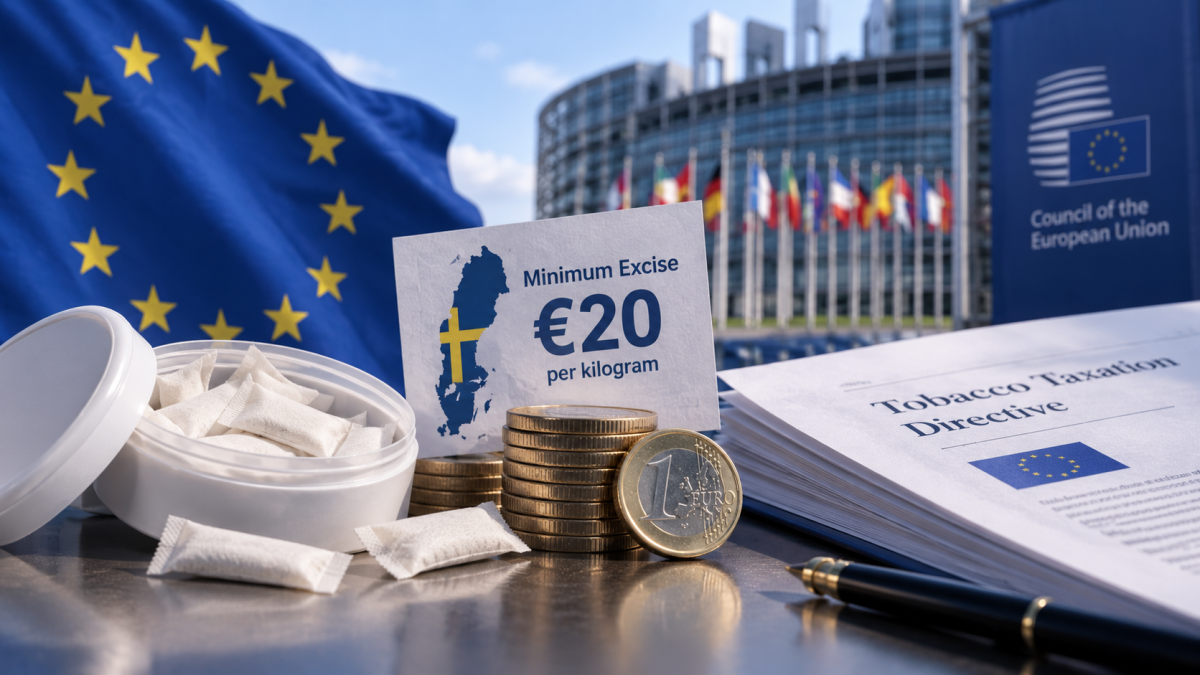
The Irish presidency of the Council of the European Union is using bilateral talks to push the bloc’s Tobacco Taxation Directive toward a political agreement in November. According to Law360, citing an EU official, Sweden is unwilling to accept a minimum excise threshold above €20 per kilogram for nicotine pouches. Council negotiations have already lowered the European Commission’s original proposal, but a May 2026 presidency compromise still set the minimum at 10% of the tax-inclusive retail price or €30 per kilogram in 2028-29, with higher levels later.

Key Points

  •  The Irish Council presidency is seeking to move the tobacco-tax proposal through higher-level negotiations in October and November and reach political agreement at Ecofin.
  •  Sweden is unwilling to accept a nicotine-pouch minimum above €20 per kilogram, according to an EU official cited by Law360.
  •  A May 2026 presidency compromise proposed minimums of 10% of the tax-inclusive retail price or €30 per kilogram in 2028-29, 25% or €50 in 2030-31, and 50% or €80 thereafter.
  •  The directive requires unanimity among EU member states in the Council, giving continued national objections significant weight.

2Firsts

September 17, 2026

According to Law360 on September 15, 2026, the Irish presidency of the Council of the European Union is using bilateral talks to advance a proposed overhaul of the bloc’s Tobacco Taxation Directive, with the aim of securing a political agreement before an Economic and Financial Affairs Council, or Ecofin, meeting in November. Sweden’s position on minimum excise duties for nicotine pouches remains one of the main unresolved issues.

The European Commission proposed a recast of the Tobacco Taxation Directive in July 2025 to raise minimum excise rates on traditional tobacco and extend the EU framework to newer products including e-cigarette liquids, heated tobacco and nicotine pouches. The proposal is a tax measure that requires unanimity among member states in the Council.

Sweden Resists a Threshold Above €20 per Kilogram

Sweden is currently unwilling to accept a minimum excise threshold for nicotine pouches above €20 per kilogram, according to an EU official cited by Law360. The position remains despite offers from the Irish presidency for more flexible phase-in arrangements.

That level is below the rates contained in an earlier public Council presidency compromise.

A compromise text dated May 29, 2026, proposed a minimum tax on nicotine pouches and other nicotine products of 10% of the tax-inclusive retail price or €30 per kilogram in 2028-29. The threshold would rise to 25% or €50 per kilogram in 2030-31, and then to 50% or €80 per kilogram after the transition.

The €30-per-kilogram starting amount in the May compromise remains above the €20 level attributed to Sweden by Law360.

Council Talks Have Already Reduced the Commission Proposal

The European Commission’s original 2025 proposal set higher monetary minimums.

Under that proposal, nicotine pouches would face a minimum excise duty of 25% of the tax-inclusive retail price or €71.5 per kilogram from 2030, rising to 50% or €143 per kilogram from 2032.

Council negotiations subsequently lowered the monetary thresholds and introduced transitional stages. The May 2026 compromise reduced the long-term monetary minimum to €80 per kilogram, with interim levels of €30 and €50.

The compromise text also introduced a mechanism allowing minimum rates to be adjusted according to member-state price levels, adding flexibility for countries with different economic conditions.

Reform Also Covers E-Cigarette Liquids and Other New Products

The proposed revision extends beyond nicotine pouches.

The Commission wants to bring e-cigarette liquids, heated tobacco, nicotine pouches and other newer nicotine products into a harmonized EU excise framework, while also raising minimum rates on some traditional tobacco products and strengthening controls on raw tobacco.

The May 2026 presidency compromise proposed the following minimum rates for e-cigarette liquids:

  •  20% of the tax-inclusive retail price or €0.20 per milliliter in 2028-29;
  •  20% or €0.25 per milliliter in 2030-31;
  •  30% or €0.36 per milliliter thereafter.

The rates would apply to e-cigarette liquids both with and without nicotine.

The reform also seeks to bring raw tobacco into the EU’s electronic excise movement and monitoring system to strengthen oversight of cross-border flows.

Irish Presidency Seeks November Political Agreement

According to EU officials cited by Law360, the Irish presidency wants the proposal to move to a high-level Council working party on October 26, then to the Committee of Permanent Representatives, or Coreper, on November 4, before a planned Ecofin discussion on November 9.

The timetable remains a presidency objective and depends on progress among member states.

Because the tax directive requires unanimity in the Council, a continuing objection from any member state could prevent adoption.

Law360 reported that Sweden is not the only country with concerns. Malta and other member states have also raised questions about whether rapid increases in minimum rates could contribute to illicit-market activity and tax avoidance.

Sweden Has a Distinct Oral-Tobacco Policy Background

Sweden occupies a distinct position in EU rules on oral tobacco. Traditional snus is generally prohibited from being placed on the market in other EU member states, but Sweden secured a derogation when it joined the bloc.

Traditional snus and tobacco-free nicotine pouches are legally distinct product categories under EU rules. The proposed tax directive separately defines nicotine pouches as tobacco-free, nicotine-containing products intended for oral use and would establish EU-wide minimum excise duties for the category.

The minimum tax on nicotine pouches remains one of the main unresolved issues in the negotiations.

The Irish presidency has said it will continue bilateral engagement with the aim of securing unanimous political agreement before the November Ecofin meeting.

Follow 2Firsts for timely updates on global tobacco and nicotine regulations, market developments and industry trends.

Cover Image generated by AI

California Lawmakers Pass Disposable Nicotine Vape Ban, With Sales Prohibition Set for 2028
According to CBS Los Angeles on August 27, 2026, California lawmakers have passed Assembly Bill 762, which would phase out disposable, battery-embedded nicotine vapes in the state. If signed by Governor Gavin Newsom, manufacturing and importation of the covered products would be prohibited beginning January 1, 2027, followed by a sales ban on January 1, 2028. Driven primarily by concerns over electronic waste, lithium-battery fires and environmental pollution, the legislation would further shift California’s legal vape market toward rechargeable, refillable or replaceable-pod devices.
Aug.28
UAE Sets Dh1-Per-ml Minimum Excise Price for Vape Liquids From Sept. 1 While Keeping 100% Tax Rate
The UAE Ministry of Finance will introduce a minimum excise price for e-liquids used in vaping and electronic smoking devices from September 1, 2026. The minimum excise price will be set at AED 1 per millilitre. The existing 100% excise tax rate will continue to apply to tobacco and electronic smoking products. The measure changes the minimum taxable base rather than the tax rate, with the UAE government saying it aims to establish unified tax standards, improve market compliance and prevent pricing loopholes.
Regulations
Aug.07 by 2Firsts Perspectives
Ohio Supreme Court Weighs Whether State Consumer Law Can Restrict Flavored Vape Sales
The Ohio Supreme Court is hearing a case involving flavored vape sales and whether state authorities can use consumer protection laws to take action against retailers selling unauthorized vape products. Ohio officials argue that selling unauthorized flavored vapes may constitute consumer deception, while retailers argue that tobacco product regulation falls under federal Food and Drug Administration (FDA) authority and that states cannot impose additional restrictions through consumer laws. The case could affect the scope of state-level vape regulation across the United States.
Aug.06
Malaysia Withdraws Appeal Against Liquid Nicotine Ruling as Vape Regulation Framework Enters New Phase
Malaysia’s government has withdrawn its appeal against a High Court ruling concerning the regulatory status of liquid nicotine used in vape and e-cigarette products, according to reports by New Straits Times, Free Malaysia Today and CodeBlue on August 18, 2026. The Kuala Lumpur High Court ruled on May 15 that the government’s decision to remove liquid nicotine from the scheduled poisons list under the Poisons Act 1952 was irrational and made without proper consultation with the Poisons Board. The withdrawal ends the government’s appeal process, while the future regulatory framework for nicotine vape products remains under discussion.
Aug.21
Malaysia Police Seize RM12.7 Million in Illegal Vapes and Cigarettes as Probe Points to Sea Shipments From China
Police in Malaysia’s Selangor state seized illegal vape products and contraband cigarettes worth about RM12.7 million (approximately $3 million) in two enforcement operations. According to New Straits Times and The Star, the vape-related operation uncovered 131,036 boxes of vape products, 4,900 bottles of e-liquid and 25,510 vape devices, valued at about RM9.4 million. Police said preliminary investigations indicated that some illegal vape products entered Malaysia through sea shipments from China before moving through storage and distribution networks.
Aug.10
South Korean Lawmaker Jeong Jin-wook Pushes Synthetic Nicotine Vape Probe, Highlighting Supply Chain and Tax Concerns
South Korean lawmaker Jeong Jin-wook has again called for stronger government action against liquid synthetic nicotine vape manufacturers and sellers, alleging that some businesses may have avoided regulation through product labeling changes and corporate restructuring. According to Newsworks, JNILBO and other Korean reports, Jeong has held his third press conference on the issue, calling for a government-wide investigation. The dispute involves whether synthetic nicotine products should fall under tobacco regulations, tax implications and supply-chain transparency. South Korean government agencies have previously said some estimates of potential tax losses cannot be verified due to limited sales data.
Jul.27